

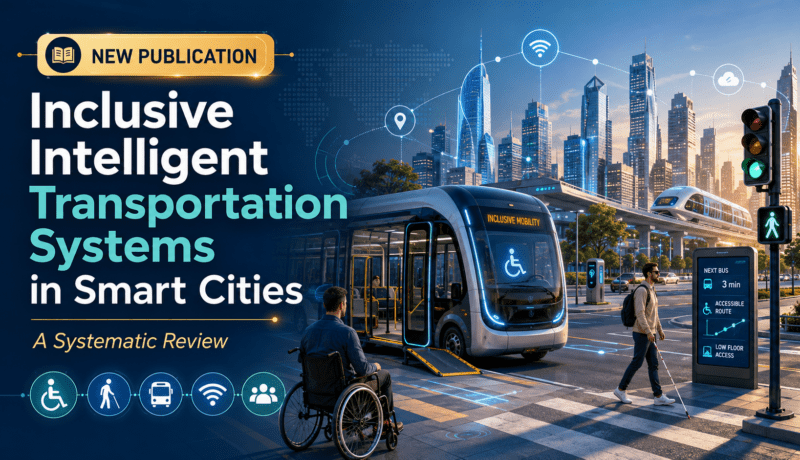
A systematic review of inclusive intelligent transportation systems in smart cities

New Publication | Discover Cities, 2026
Table Of Content
- Making Smart Mobility Truly Inclusive
- A Large-Scale Systematic and Bibliometric Review
- Key Findings
- AI and Emerging Technologies for Accessible Transportation
- From Technology-Centered ITS to Human-Centered Smart Mobility
- Accessibility, Ethics, and Policy Must Work Together
- Learning from Leading Smart Cities
- Where Should Research Go Next?
- Smart Cities Must Be Inclusive Cities
- Publication Details
I am pleased to share our newly published open-access review article:
“A Systematic Review of Inclusive Intelligent Transportation Systems in Smart Cities”
The article is published in Discover Cities, Volume 3, Article 144 (2026), and provides a comprehensive investigation of how Artificial Intelligence (AI), Deep Learning (DL), Internet of Things (IoT), smart sensors, and intelligent transportation technologies can contribute to more accessible and inclusive mobility in future smart cities.
DOI: 10.1007/s44327-026-00328-7
Making Smart Mobility Truly Inclusive
Cities around the world are rapidly adopting intelligent transportation technologies to improve traffic management, public transportation, sustainability, safety, and urban mobility. However, technological intelligence alone does not necessarily guarantee accessibility.
People with physical, visual, auditory, and cognitive disabilities continue to face significant barriers when interacting with transportation systems. These barriers may include inaccessible infrastructure, insufficient assistive technologies, poorly designed digital services, limited real-time accessibility information, inconsistent policies, and the lack of personalized mobility support.
This review therefore addresses an important question:
How can Intelligent Transportation Systems become not only smarter, but also more inclusive, accessible, ethical, and responsive to the needs of people with disabilities?
A Large-Scale Systematic and Bibliometric Review
The study combines a PRISMA-based systematic review with an extensive bibliometric analysis to examine the development of disability-inclusive Intelligent Transportation Systems (ITS).
Three comprehensive Scopus searches initially identified 4,549 records covering the period 2021–2026. After duplicate removal, screening, and the application of predefined inclusion and exclusion criteria, 2,253 studies were retained for the final systematic and bibliometric analyses.
The analysis also employed bibliometric and visualization tools, including Scopus analytical tools and VOSviewer, to investigate publication trends, keyword relationships, collaboration networks, thematic areas, and emerging research directions.
Key Findings
- 66.0% of the analyzed research focuses on general accessibility frameworks, while substantially less attention is given to disability-specific solutions.
AI and Emerging Technologies for Accessible Transportation
The review examines how several AI and smart-system technologies can contribute to accessible urban mobility, including:
- Artificial Intelligence and Machine Learning
- Deep Learning
- Computer Vision
- Natural Language Processing
- Sensor Fusion
- Internet of Things (IoT)
- Vehicle-to-Everything (V2X) communication
- Smart sensors and wearable devices
- Digital Twins
- Autonomous mobility systems
- Smart parking systems
- Assistive navigation technologies
These technologies have the potential to support real-time navigation, hazard detection, accessible pedestrian crossings, adaptive routing, personalized transportation services, intelligent traffic management, and greater mobility independence.
From Technology-Centered ITS to Human-Centered Smart Mobility
One of the major contributions of the study is moving beyond a purely technology-oriented view of Intelligent Transportation Systems.
The paper integrates several interconnected perspectives:
- Artificial Intelligence and intelligent systems
- Transportation engineering
- Accessibility and disability inclusion
- Human-centered design
- Urban planning
- Ethical AI
- Smart-city policies
- Datasets and sensors
- Sustainability
- Real-world deployment
Disability-inclusive ITS solutions are organized across four major dimensions:
- Mobility-oriented solutions for individuals with physical impairments and wheelchair users.
Accessibility, Ethics, and Policy Must Work Together
The development of inclusive ITS cannot depend on technology alone.
The review emphasizes the importance of integrating international accessibility standards, regulatory frameworks, ethical principles, and trustworthy AI practices into the development of future transportation systems.
The study discusses frameworks and standards including:
- Web Content Accessibility Guidelines (WCAG)
- ISO smart-city indicators and standards
- General Data Protection Regulation (GDPR)
- Trustworthy and ethical AI principles
Dataset representativeness, transparency, privacy, fairness, explainability, interoperability, and accountability should therefore be considered fundamental requirements of future AI-enabled transportation systems.
Learning from Leading Smart Cities
The article also examines real-world smart transportation practices across several leading cities, including:
- Singapore
- Amsterdam
- Barcelona
- London
- New York City
- Tokyo
- Dubai
These cities demonstrate different approaches to combining AI, IoT, sustainable transportation, accessible infrastructure, universal design, autonomous mobility, real-time transportation information, and assistive technologies.
Among the examples highlighted in the study:
- Singapore and Amsterdam demonstrate strong leadership in sustainable intelligent transportation.
Where Should Research Go Next?
The study identifies several important directions for the next generation of inclusive Intelligent Transportation Systems.
- Conduct large-scale real-world validation of accessibility-oriented ITS solutions.
Smart Cities Must Be Inclusive Cities
The central message emerging from this research is simple:
A smart city cannot be considered truly smart if its transportation systems leave part of society behind.
Future Intelligent Transportation Systems should therefore be not only more intelligent and efficient, but also adaptive, accessible, explainable, trustworthy, sustainable, and human-centered.
By bringing together technological innovation, accessibility, policy, ethics, and human-centered design, disability-inclusive ITS can contribute to transportation systems that enable greater independence and equitable mobility for everyone.
Publication Details
Title:
A Systematic Review of Inclusive Intelligent Transportation Systems in Smart Cities
Authors:
Mahmoud Badawy, Tamer Ahmed Farrag, Hanaa A. Sayed, Rasha ElAgamy, Malik Almaliki, Hanaa ZainEldin, and Mostafa A. Elhosseini
Journal: Discover Cities
Year: 2026
Volume / Article: 3:144
Article Type: Review
Access: Open Access
DOI: 10.1007/s44327-026-00328-7
Download / Read the Full Paper (PDF)
This article is published Open Access under the Creative Commons Attribution-NonCommercial-NoDerivatives 4.0 International License (CC BY-NC-ND 4.0).
Keywords: Artificial Intelligence, AI, Deep Learning, Intelligent Transportation Systems, ITS, Smart Cities, Smart Mobility, Accessibility, Disability Inclusion, Inclusive Transportation, IoT, Assistive Technology, Human-Centered AI, Sustainable Transportation


No Comment! Be the first one.