
Calibrated adaptive framework for trustworthy human and artificial intelligence decision systems

Artificial Intelligence is increasingly being deployed in safety-critical decision-making environments, from predictive maintenance and industrial operations to healthcare and strategic management. Yet achieving high predictive accuracy alone is not enough.
Table Of Content
- From Static AI Assistance to Adaptive Human–AI Teaming
- What Is CAHAT?
- 1. Adaptive Human–AI Reliance
- 2. Probability Calibration
- 3. Epistemic Uncertainty Quantification
- 4. Semantic Explainability
- Evaluating the Framework
- Key Results
- A Key Finding: Human Bias Can Become the Dominant Failure Mode
- Why This Matters
- From Automation to Intelligent Teaming
- Important Limitation and Future Direction
- The Bigger Picture
A more fundamental challenge remains:
How can humans and AI reliably work together when AI confidence may be miscalibrated, human judgment may be biased, and operating conditions continuously change?
Our recently published research introduces a new framework designed to address this challenge: Calibrated Adaptive Human–AI Teaming (CAHAT).
From Static AI Assistance to Adaptive Human–AI Teaming
Many existing Human–AI decision systems treat artificial intelligence as a relatively static advisor. Such approaches may assume that AI probabilities are already reliable, that human trust remains fixed, and that decision makers behave consistently.
Real-world environments are very different.
Under operational pressure:
- AI models may become overconfident.
- Human decision makers may underestimate risk.
- Trust in AI may become poorly calibrated.
- Distribution shifts may reduce model reliability.
- Fixed Human–AI weighting may fail when conditions change.
CAHAT approaches Human–AI collaboration differently.
Instead of treating trust and reliance as fixed parameters, the framework views Human–AI decision making as a closed-loop adaptive control process.
What Is CAHAT?
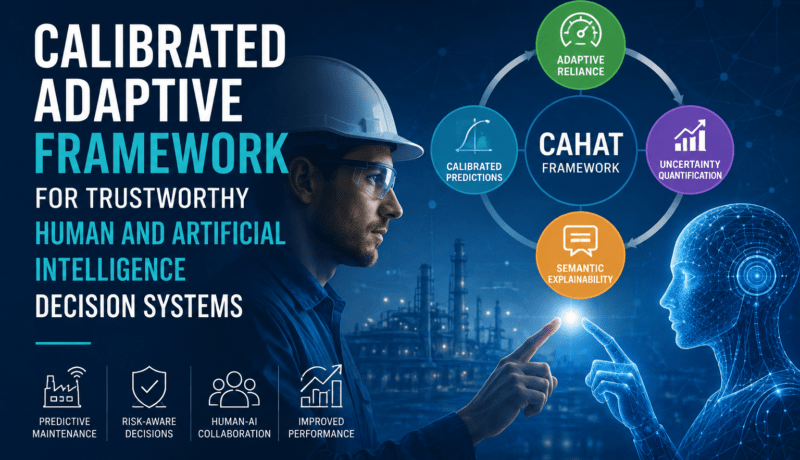
CAHAT — Calibrated Adaptive Human–AI Teaming — dynamically regulates how much decision authority should be assigned to the human and how much should be assigned to the AI.
The framework integrates four complementary mechanisms.
1. Adaptive Human–AI Reliance
A dynamic balance parameter θ controls the relative contribution of human and AI decisions.
Rather than keeping this parameter fixed, CAHAT updates it according to observed outcomes and the performance discrepancy of each decision maker.
The system can therefore progressively place greater reliance on whichever agent is demonstrating more reliable performance.
2. Probability Calibration
Modern AI models can generate highly confident predictions that do not necessarily correspond to real-world probabilities.
CAHAT applies temperature scaling to calibrate AI predictions so that predicted risks more accurately reflect observed risks.
For safety-critical decision systems, this distinction is essential.
A predicted failure probability should represent meaningful risk—not merely model confidence.
3. Epistemic Uncertainty Quantification
The framework uses Monte Carlo Dropout to estimate epistemic uncertainty.
This allows the AI system to communicate not only:
“What do I predict?”
but also:
“How certain am I about this prediction?”
Uncertainty is explicitly incorporated into decision utility, reducing the likelihood that an overconfident model dominates decision making when operating outside familiar conditions.
4. Semantic Explainability
Technical AI outputs are translated into meaningful, human-understandable explanations.
Instead of presenting managers only with probabilities or complex model outputs, the framework can translate predictions into actionable decision-oriented information.
This supports more effective interaction between machine intelligence and human judgment.
Evaluating the Framework
CAHAT was evaluated using a physics-informed predictive maintenance simulator designed to reproduce important characteristics of industrial decision environments.
The simulation incorporates:
- stochastic machine degradation,
- changing failure risk,
- production-pressure bias,
- human risk underestimation,
- uncertainty in AI predictions,
- maintenance costs,
- catastrophic failure penalties, and
- dynamic Human–AI feedback.
This controlled environment makes it possible to systematically study how different decision strategies behave under risk and operational pressure.
Key Results
The results demonstrate the importance of combining calibration, uncertainty awareness, and adaptive collaboration.
The Adaptive Hybrid Human–AI protocol achieved a cumulative reward of:
6,887.6
compared with:
−1,982.8 for the Human-only baseline.
Even more importantly, the adaptive framework achieved a near-zero failure rate of only 0.8% under the tested conditions.
The experiments also revealed a striking difference between calibrated and uncalibrated AI.
The uncalibrated AI failed 12.4% of the time, demonstrating that high model capability alone does not guarantee trustworthy decision making.
Calibration therefore emerged as a foundational component of reliable Human–AI collaboration.
A Key Finding: Human Bias Can Become the Dominant Failure Mode
Sensitivity experiments produced another important observation.
Under the simulated conditions, human cognitive bias—not AI model capability—became the dominant source of failure as production pressure increased.
This finding highlights an important principle for future intelligent decision systems:
Trustworthy AI should not be designed only to improve algorithms. It should be designed to regulate the interaction between human judgment and machine intelligence.
An effective Human–AI system should therefore recognize both machine uncertainty and human cognitive limitations.
Why This Matters
The future of AI in high-stakes environments may not simply be about replacing human decision makers with increasingly autonomous models.
A more practical direction is intelligent teaming.
Humans contribute contextual understanding, experience, accountability, and domain knowledge.
AI contributes computational consistency, probabilistic reasoning, pattern recognition, and large-scale information processing.
The challenge is determining when each should be trusted—and by how much.
CAHAT addresses this problem by continuously adapting reliance according to observed performance rather than relying on static assumptions.
From Automation to Intelligent Teaming
The central idea behind CAHAT can be summarized simply:
Do not treat Human–AI collaboration as static automation. Treat it as a dynamically regulated system.
Trust should evolve with performance.
AI probabilities should be calibrated.
Uncertainty should be quantified.
Reliance should adapt according to evidence.
And AI outputs should remain understandable to human decision makers.
Together, these principles provide a pathway toward more trustworthy, resilient, and adaptive Human–AI decision systems.
Important Limitation and Future Direction
The current findings were obtained using a controlled physics-informed simulation environment.
Accordingly, the results should be interpreted as simulation-based evidence for the proposed Human–AI teaming architecture.
An essential next step is empirical validation using:
- real operational datasets,
- real industrial environments, and
- real human operators.
Such validation will help determine how adaptive reliance, calibrated trust, uncertainty awareness, and cognitive behavior interact in real-world Human–AI teams.
The Bigger Picture
As AI increasingly enters safety-critical environments, the central question is shifting from:
“How accurate is the AI?”
to:
“How should humans and AI dynamically collaborate when neither is perfectly reliable?”
CAHAT represents one step toward answering that question.
Rather than pursuing automation alone, the framework moves toward calibrated, adaptive, and trustworthy Human–AI teaming.
Keywords: Human–AI Collaboration, Trustworthy AI, Human–AI Teaming, Adaptive Decision-Making, Artificial Intelligence, Explainable AI, Uncertainty Quantification, Probability Calibration, Predictive Maintenance, Cognitive Bias, Decision Support Systems, CAHAT
for your reference, the full manuscript



No Comment! Be the first one.