
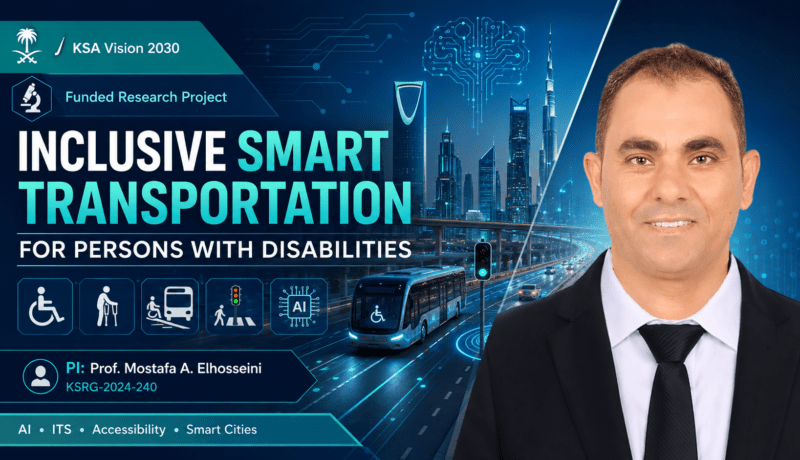
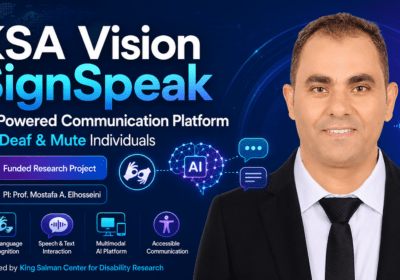
This funded research project investigates intelligent transportation systems designed to improve mobility, accessibility, safety, and independence for persons with disabilities in future smart-city environments. The project integrates artificial intelligence, machine learning, deep learning, computer vision, reinforcement learning, acoustic intelligence, traffic optimization, and accessibility-aware routing to develop more inclusive urban transportation solutions aligned with KSA Vision 2030.
Table Of Content
Project at a Glance
| Metadata | Details |
|---|---|
| Project Type | Funded Research & Innovation Project |
| Principal Investigator | Prof. Mostafa A. Elhosseini |
| Funder | King Salman Center for Disability Research |
| Research Group No. | KSRG-2024-240 |
| Contract Date | 21 October 2024 |
| Duration | 12 months |
| Research Area | Intelligent Transportation Systems, AI & Disability-Inclusive Smart Cities |
| Strategic Context | KSA Vision 2030 |
| Published Outputs Attached | 4 peer-reviewed articles |
Publications & Research Outputs
1. Sound-Based Vehicle Diagnostics & Emergency Recognition
Toward Inclusive Smart Cities: Sound-Based Vehicle Diagnostics, Emergency Signal Recognition, and Beyond
Machines, 2025, 13, 258
DOI: 10.3390/machines13040258
The work develops sound-based vehicle-fault and emergency-signal recognition for inclusive ITS environments, including new acoustic datasets and machine-learning models.
2. Adaptive Traffic-Light Management
Adaptive Traffic Light Management for Mobility and Accessibility in Smart Cities
Sustainability, 2025, 17, 6462
DOI: 10.3390/su17146462
The paper proposes the H-ATLM system using DDPG reinforcement learning for dynamic traffic control, reporting congestion reductions of up to 50%, throughput improvements of up to 149%, and clearance-time reductions of up to 84%.
3. Mobility-Aid Detection & Accessibility-Aware Routing
Alexandria Engineering Journal, 2025, 129, 1279–1298
DOI: 10.1016/j.aej.2025.08.044
This work integrates YOLOv10 and Faster R-CNN for wheelchair/crutch detection with traffic-severity prediction and accessibility-aware route optimization. It reports 99.4% mAP for general mobility aids, 100% recall, and a 17.3% reduction in disabled-user travel time under peak congestion.
Most importantly for your project page, its contribution statement explicitly credits:
4. Explainable Audio-Based ITS
Machines, 2025, 13, 888
DOI: 10.3390/machines13100888
The study develops an interpretable acoustic-ML framework using MFCCs, Mel spectrograms, Chroma features, SHAP, Boruta, ANOVA, and ensemble learning for vehicle faults and emergency sounds.


No Comment! Be the first one.