
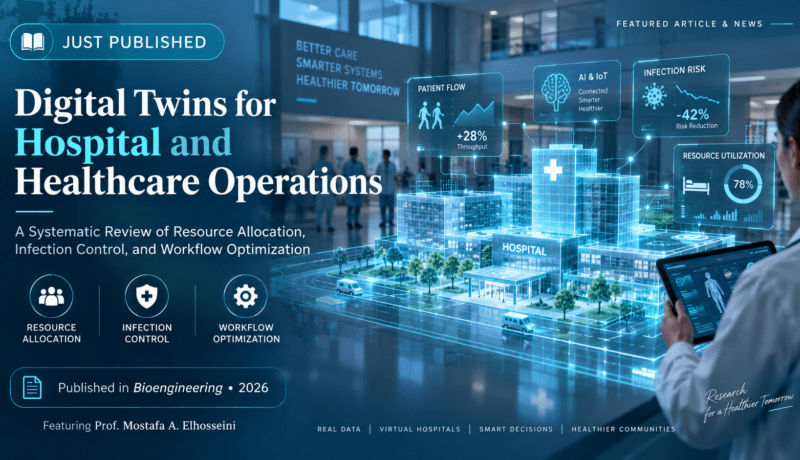
Digital Twins for Hospital and Healthcare Operations: A Systematic Review of Resource Allocation, Infection Control, and Workflow Optimization

Just Published in Bioengineering
I am delighted to share our newly published systematic review:
Table Of Content
“Digital Twins for Hospital and Healthcare Operations: A Systematic Review of Resource Allocation, Infection Control, and Workflow Optimization”
authored by Nesma Abd El-Mawla, Mohamed Shehata, and Mostafa A. Elhosseini, and published in Bioengineering on 15 September 2026.
The paper is published as an open-access article under the Creative Commons Attribution (CC BY) license, making it freely accessible to researchers, students, healthcare professionals, and interested readers.
Article Summary
Digital Twin technology is increasingly moving beyond individual patient modeling toward the representation and optimization of entire healthcare facilities and hospital operations.
This systematic review examines how Digital Twins, together with Artificial Intelligence and the Internet of Things, can support smarter and more adaptive healthcare systems.
The study reviewed peer-reviewed research published between 2021 and 2026, with 70 studies ultimately included in the analysis. The review identifies growing applications of AI-enabled Digital Twins in real-time monitoring, predictive maintenance of medical equipment, surgical planning, resource utilization, and hospital decision-making.
In hospital environments, Digital Twins can support the allocation of beds and staff, real-time monitoring of patient movements, prediction and mitigation of infection risks, and data-driven operational decision-making.
Why This Research Matters
Hospitals operate as highly complex systems involving patients, healthcare professionals, medical equipment, physical infrastructure, scheduling systems, and large volumes of heterogeneous data.
Digital Twins provide a way to build a continuously updated virtual representation of these systems and use simulation, AI, and real-time data to explore operational decisions before implementing them in the physical hospital.
The review highlights an important transition:
Reactive Healthcare → Predictive Healthcare → Intelligent & Adaptive Smart Hospitals
It also identifies major limitations of current implementations, including fragmented Digital Twins focused on isolated hospital functions, limited prescriptive decision-making, and interoperability problems involving EHRs, wearable devices, sensors, and building-management systems.
Main Contributions
The article goes beyond a conventional technology-focused review and examines Digital Twins from a broader sociotechnical and sustainability perspective.
The major contributions include:
- A systematic review of Digital Twins for hospital and healthcare operations, covering their theoretical foundations and practical applications.
- Analysis of metrics, standards, benchmark simulators, and datasets used to assess healthcare Digital Twins.
- Detailed examination of the integration of Artificial Intelligence and IoT with Digital Twin technology.
- Investigation of the relationship between technical efficiency and human factors, including patients’ rights, sociological considerations, sustainability, and system self-regulation.
- Identification of research gaps, challenges, and future directions for healthcare Digital Twins.
- Consideration of the ethical and sustainability dimensions of AI-enabled healthcare systems rather than focusing exclusively on technical performance.
Key Application Areas
The review particularly focuses on four major operational areas:
Resource Allocation
Digital Twins can support intelligent allocation of:
Hospital beds · Staff · Medical equipment · Clinical resources · Infrastructure
Operational/Hospital Digital Twins are specifically intended to improve hospital efficiency by optimizing resources while supporting infection-control requirements.
Infection Control
Digital Twins can combine real-time data, predictive models, AI, and sensor systems to:
Monitor infection risks · Model disease transmission · Support preventive interventions · Improve hospital safety
Workflow Optimization
Digital Twins provide opportunities to simulate and improve:
Patient flow · Scheduling · Clinical processes · Bottlenecks · Operating-room workflows · Hospital logistics
Smart Hospital Infrastructure
The technology ecosystem combines Digital Twins with:
AI · Machine Learning · Deep Learning · IoT · Cloud Computing · Edge/Fog Computing · Big Data Analytics · Blockchain
to support increasingly intelligent healthcare environments.
Methodology
The study follows the PRISMA 2020 guidelines for systematic reviews, including identification, screening, eligibility assessment, and final inclusion.
The literature search was conducted using the Scopus database and covered publications from 2021–2026. The initial search identified 76 documents, and 70 studies were included in the final review.
The research combines:
Systematic Literature Review + Bibliometric Analysis + Content Analysis
to explore both the scientific development of the field and the practical application of Digital Twins in healthcare.
Toward the Future of Smart Hospitals
The review indicates that the future of healthcare Digital Twins will depend on addressing several important challenges, including:
Data interoperability · Security · Privacy · Ethical governance · Real-time synchronization · Model accuracy · Scalability · Federated Learning · Human-centered design
A major future direction is the evolution from Digital Twins that simply visualize hospital conditions toward systems capable of prediction, recommendation, and eventually more autonomous decision support.
How to Cite This Paper
Recommended Citation
Abd El-Mawla, N.; Shehata, M.; Elhosseini, M.A. Digital Twins for Hospital and Healthcare Operations: A Systematic Review of Resource Allocation, Infection Control, and Workflow Optimization. Bioengineering 2026, 13, 1072.
DOI: 10.3390/bioengineering13091072
Download the Full Paper
Interested researchers, students, healthcare professionals, and visitors are welcome to read the complete open-access article.
I hope this work contributes to the growing discussion around Digital Twins, AI, IoT, and the future of intelligent healthcare operations. I am pleased to share the paper openly with researchers, students, professionals, and anyone interested in how emerging technologies can contribute to smarter, safer, and more sustainable hospitals.


No Comment! Be the first one.