

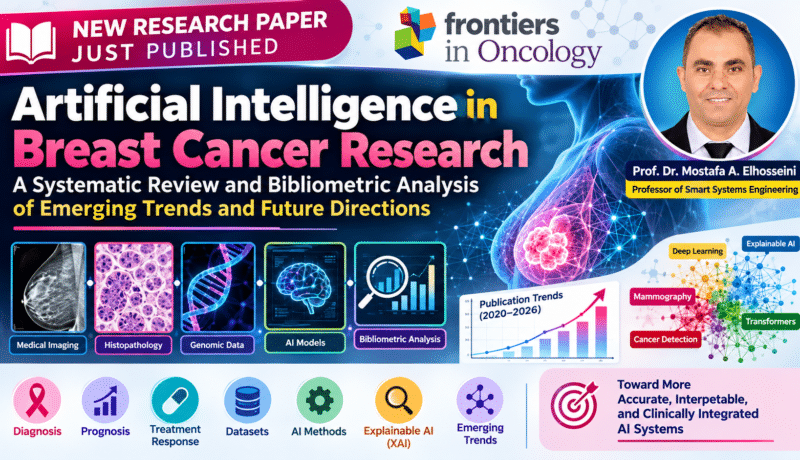
Just Published: Mapping the Future of AI in Breast Cancer Research

Our new systematic review and bibliometric analysis explores how AI, deep learning, explainability, transformers, and multimodal learning are reshaping breast cancer research.
The paper, “Artificial intelligence in breast cancer research: a systematic review and bibliometric analysis of emerging trends and future directions,” was published in Frontiers in Oncology on 28 September 2026. The authors are Yathreb Bayan Mohamed, Hanaa ZainEldin, Shymaa G. Eladl, Hanaa A. Sayed, Mohamed Shehata, Mahmoud Badawy, and Mostafa Elhosseini. fonc-16-1800218
Table Of Content
- Our new systematic review and bibliometric analysis explores how AI, deep learning, explainability, transformers, and multimodal learning are reshaping breast cancer research.
- About the Study
- How the Study Was Conducted
- Key Findings
- Emerging AI Hotspots
- Main Contributions
- From Research Accuracy to Clinical Impact
- Why This Paper May Be Useful to Researchers
- How to Cite the Paper
- Read & Download the Paper
- Join the Discussion
I am pleased to share our newly published research in Frontiers in Oncology. This systematic review and bibliometric analysis examines how Artificial Intelligence is transforming breast cancer research, from diagnosis and medical imaging to explainability, optimization, emerging transformer architectures, and future clinical integration.
I invite researchers, students, healthcare professionals, and AI enthusiasts to read the paper, cite it in related work, and share their thoughts and questions. I would be very interested to hear your perspective on where AI in breast cancer research is heading next.
About the Study
Breast cancer research has increasingly adopted artificial intelligence, machine learning, and deep learning to analyze complex medical imaging, pathological, genomic, and clinical data. At the same time, the literature has become fragmented across different clinical tasks, data modalities, algorithms, datasets, and software ecosystems. This work was designed to map that rapidly evolving landscape and identify the research directions that are becoming most important. fonc-16-1800218
The study goes beyond conventional citation analysis by examining clinical tasks, explainable AI, hyperparameter optimization, datasets, software frameworks, mammography, algorithmic trends, and emerging architectures such as Vision Transformers.
How the Study Was Conducted
The review used Scopus and Web of Science as its primary databases and employed a systematic bibliometric framework combining performance analysis, science mapping, and thematic evolution. fonc-16-1800218
Three complementary search strategies initially produced 4,831 records. After deduplication, screening, and eligibility assessment, the final bibliometric and science-mapping dataset contained 608 peer-reviewed journal articles and reviews published between 2020 and 2026.
Key Findings
One of the strongest findings is that diagnosis remains the dominant AI application in breast cancer research, accounting for 71.22% of the analyzed studies. Prognosis accounted for 27.47%, while treatment-response prediction represented only 2.30%, highlighting an important area for future research. fonc-16-1800218
The study also shows that breast cancer AI research has expanded rapidly in recent years, particularly after 2022, reflecting growing interest in AI-driven detection, diagnostic technologies, and clinical decision support. fonc-16-1800218
Mammography remains the dominant imaging modality, appearing in 256 studies, or 42.11% of the dataset, followed by ultrasound and histopathology.
Emerging AI Hotspots
The bibliometric evidence reveals an important shift in the field.
Traditional deep learning and CNNs remain core technologies, but several newer areas show stronger growth:
- Explainable AI (XAI) — identified as an emerging hotspot.
- Transformers and Vision Transformers — showing rapid adoption.
- Attention mechanisms — demonstrating rapid growth.
- Multimodal learning — emerging as an important research direction.
- Transfer learning — remaining a stable core methodology. fonc-16-1800218
This suggests a broader transition from simply maximizing predictive accuracy toward developing AI systems that are interpretable, multimodal, reproducible, and clinically robust.
Main Contributions
This paper differs from many earlier bibliometric studies by taking a task-aware and methodology-centered perspective.
Its major contributions include:
- Mapping AI research separately across diagnosis, prognosis, and treatment-response prediction.
- Analyzing the adoption of Explainable AI and hyperparameter optimization.
- Tracking the methodological evolution from conventional machine learning to deep learning and transformer-based architectures.
- Examining the datasets, software frameworks, and computational ecosystems that affect reproducibility.
- Identifying fast-growing research hotspots with strong clinical relevance. fonc-16-1800218
From Research Accuracy to Clinical Impact
A central message of the paper is that the future of AI in breast cancer research will not depend only on higher classification accuracy.
The field is moving toward systems that are:
Explainable · Multimodal · Reproducible · Clinically Integrated · Human-Centered
Recent research increasingly emphasizes interpretable AI frameworks, diverse data sources, and clinically deployable diagnostic systems. fonc-16-1800218
The paper therefore points toward a future in which AI supports clinicians through more transparent, robust, and clinically meaningful decision-support systems rather than functioning simply as a standalone prediction engine.
Why This Paper May Be Useful to Researchers
This review can serve as a starting point for researchers interested in:
AI in Breast Cancer · Medical Imaging · Mammography · Deep Learning · Vision Transformers · Explainable AI · Multimodal Learning · Hyperparameter Optimization · Medical AI Datasets · Clinical Decision Support · Bibliometric Analysis
It may be particularly useful for identifying research gaps, emerging technologies, benchmark datasets, methodological trends, and future thesis or project directions.
How to Cite the Paper
Mohamed, Y. B., ZainEldin, H., Eladl, S. G., Sayed, H. A., Shehata, M., Badawy, M., & Elhosseini, M. (2026). Artificial intelligence in breast cancer research: A systematic review and bibliometric analysis of emerging trends and future directions. Frontiers in Oncology, 16, 1800218. https://doi.org/10.3389/fonc.2026.1800218
Read & Download the Paper
Interested in AI, medical imaging, or breast cancer research?
Read the full open-access paper, explore the results, and feel free to cite it in your related work. I also welcome your comments and discussion about the future of AI-assisted cancer research.
📄 Download Full Paper
🔗 Read Published Article
Join the Discussion
What do you think is the next major step for AI in breast cancer research?
Will Explainable AI, multimodal models, Vision Transformers, foundation models, or human–AI collaboration have the greatest clinical impact?
I would be delighted to hear your thoughts, questions, and research experiences in the comments.




No Comment! Be the first one.